
HVAC Glossary: Heating and Cooling Terms
Here’s an HVAC glossary for homeowners to refer to. It’s important to understand what your HVAC professionals are saying so you can make informed decisions.
Call 410-204-2662 for all your HVAC needs.
Table of Contents
Basic Heating and Cooling Terms & System Types
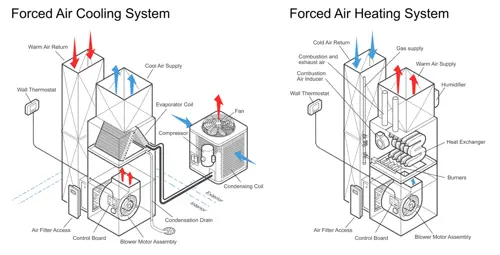
Air Handler: Also known as a fan coil, this unit consists of the evaporator coil, air filter, humidifier, and other components—depending on your model. It works by moving air over the coil to warm or cool your home.
Capacitor: An electrical device that stores and distributes energy in HVAC systems.
Compressor: This part of an air conditioning system pressurizes and circulates refrigerant, which cools your home.
Condenser: An outdoor HVAC unit that houses a motor, heat exchanger, and compressor. It works by removing heat from the refrigerant, which turns the refrigerant to liquid and completes the cooling cycle.
Ductwork: Ductwork is a series of tubes that move cool/warm air throughout your home. Ducts are made of metal, fiberglass, or plastic.
Evaporator Coil: An evaporator coil absorbs heat from the air that moves over it. When the air cools down, the resulting condensation drips into the drain pan. This whole process cools the air in your home.
Furnace: A heating unit that uses gas, oil, or electricity to heat your home. It can stand alone or as part of a larger HVAC system.
Heat Pump: A type of compressor that can push warm or cold air. It works by pushing thermal energy to either heat or cool your home.
HVAC: The acronym stands for heating, ventilation, and air conditioning. HVAC systems are complete heating and cooling systems.
Load Calculation: How professionals determine the size of a heating/cooling system needed for your building. It considers the building’s number of windows and doors, square footage, insulation, and local climate.
Mini-Split (Ductless): An HVAC system that requires no ducts to heat and cool a room or small space. It consists of an outdoor compressor and an indoor air handler.
Package Unit (RTU): An air handler unit specifically designed for outdoors. It contains everything needed to heat and cool a home. It can also be known as a rooftop unit (RTU).
Split System: A larger version of a mini-split system to heat or cool an entire building. The system is split into two parts: an outdoor compressor and an indoor air handler.
Thermostat: A device that controls the amount of heat or cooling in your home to create a comfortable environment.
VAV (Variable Air Volume): This component adjusts airflow to reach specific temperatures within a home.
Air Conditioning Terms
Condensate Drain/Pan: The drain moves water from within an AC unit into the pan to prevent leaks or unit freezing.
Refrigerant (R-410A, R-454B): A chemical that cools the air in your home. R-410A and R-454B are newer versions of refrigerants that replaced less environmentally friendly versions.
Superheat/Subcool: Superheating is warming up a vapor to create steam and is done in an evaporator. Subcooling is when heat is taken away from a liquid—usually done in a heat exchanger.
Two-Stage: An air conditioner that is designed to work on either low or high settings.
Thermostatic Expansion Valve (TXV): A device that regulates the flow of refrigerant that goes into the evaporator.
Heating Terms
AFUE (Annual Fuel Utilization Efficiency): A Department of Energy fuel efficiency measurement for furnaces. It measures how much fuel is needed to warm your home.
Flame Sensor: A safety device that senses whether a flame is present or not.
Gas Valve: Regulates the amount of gas that flows to the burners for consistent heating. If it fails, your furnace won’t work.
Heat Exchanger/Heat Transfer: A device that transfers heat between different parts of a heating system.
Igniter: Starts the fire for gas and oil furnaces.
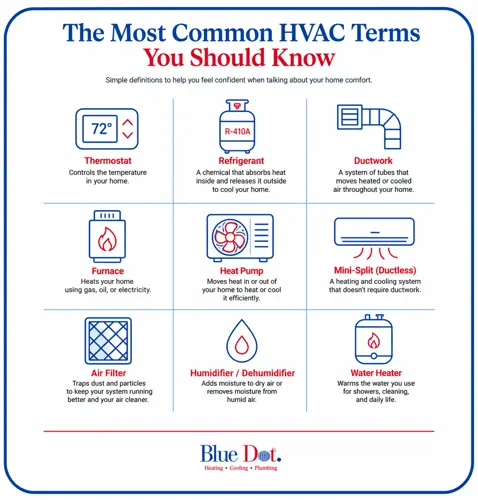
Indoor Air Quality (IAQ) Terms
Air Changes per Hour (ACH): A ventilation rate for how many times air is replaced or filtered with new air each hour.
CFM (Cubic Feet per Minute): An air conditioner’s air flow rate—the larger the number, the more air flowing.
Dehumidifier/Humidifier: Pieces of equipment that affect humidity levels in your home. A dehumidifier takes humidity away, while a humidifier adds it.
HRV/ERV (Ventilation Systems): A heat recovery ventilator (HRV) switches indoor air with outdoor air for cleaner air. An energy recovery ventilator (ERV) brings fresh air while recovering energy from exhaust air.
Infiltration: Introducing outside air to the inside of a building, usually through cracks—sometimes called air leakage.
MERV/HEPA (Air Filters): Minimum efficiency reporting value (MERV) is an air filter efficiency standard—how well it can remove particles from the air. High efficiency particulate air (HEPA) is a mechanical air filter that removes 99.97% of particles from the air.
Negative Pressure: When the air pressure in your house is lower than the pressure outdoors.
UV-C/Air Purifier: Air purifiers clean the air flowing through your home, and UV-C is a type of light used to kill germs.
Water Heater Terms
First Hour Rating/Gallons Per Minute (GPM): First hour rating is the maximum hot water volume a water tank can supply when fully heated. GPM is how much a water tank can pump water in a minute.
Recirculation Pump: A device that circulates hot water through your water heater and plumbing system.
Tank Water Heater (Gas/Electric): Also known as a storage water tank. It stores preheated water inside, giving quicker access to hot water.
Tankless (On-Demand/Instantaneous Water Heater): Tankless water heaters don’t have a storage tank. Instead, they only heat water when needed.
Temperature and Pressure (T&P) Relief Valve: A safety device that relieves water pressure by discharging water to prevent water heater failure.